El Salvador: The country that makes girls invisible
Salvadoran girls are not mentioned in the new textbooks distributed in public schools, and have increasingly less access to sex education. This investigation by Revista Factum and La Sala: Mujeres en la Redacción reveals how cuts to the basic health budget has also left them vulnerable to teenage pregnancies and school dropout.
A 10-year-old girl was playing with a 7-year-old friend in a passageway of the Alta Vista residential area in Tonacatepeque, San Salvador, when a man wearing shorts and a T-shirt approached, grabbed her shoulders, touched her vulva, and ran away.
It happened at 5 pm on Feb. 18, 2019, and did not go unpunished, as a neighbor witnessed the attack and the victim’s mother called the police. Authorities were able to identify the assailant, a man with a prominent position in the corridors of power: Jaime Eduardo Escalante, a judge in the Third Civil Chamber of San Salvador.
The family denounced the official and confronted the judicial system—which proceeded to protect him. First, the system safeguarded his job. The Supreme Court of El Salvador did not suspend the magistrate from his duties; instead, it granted him a 60-day leave of absence, tailored to his request after his arrest.
The judiciary protected the aggressor
Nine magistrates voted in favor of Escalante, despite the fact that Article 54A of the Judicial Career Law establishes conditions for the suspension of a judge or magistrate: “when the action of the judicial official or employee constitutes a danger or undermines the correct administration of justice, or has produced social scandal due to the circumstances of the facts or the quality of the persons, or when the permanence of the employee or official in his position may prevent or hinder the investigation of the matter.”
The magistrates chose to grant him a privilege enjoyed by all Supreme Court employees to avoid disciplinary action that would tarnish his administrative record. By that time, the justices had already received a police report detailing the incident in which the official was accused.
The accused had nine months of probation.
Apparently concerned only with its institutional reputation, the Supreme Court published a statement expressing regret for the handling of information about the case on social media and condemning the fact that the name of another magistrate was disclosed instead of that of the detainee.
The legal process overcame a second impasse after the Criminal Court ruled that the touching suffered by the girl did not constitute a crime. The Court offered three justifications: there was no violence involved, it occurred briefly, and it happened over the clothing of the 10-year-old victim.
That conclusion did not take into account Article 161 of the Penal Code of El Salvador, which establishes that “sexual assault carried out with or without violence that does not consist of carnal access, on a minor under 15 years of age or on another person, taking advantage of their mental alienation, their state of unconsciousness or their inability to resist, will be punished with imprisonment of eight to 12 years.”
Family of the girl forced to emigrate
In March 2022, Escalante was sentenced to 10 years in prison for sexual assault. However, the minor had dropped out of school after the incident.
The girl, her mother, and her teenage brother left El Salvador after two men knocked on their door and threatened them, demanding they drop the legal proceedings. One of the men punched the mother in the face, according to the newspaper El Faro.
Between late May and mid-June 2022, after being deported from an undisclosed country, the family was reprimanded by the National Council for Children and Adolescents (CONNA) for irregular migration. Instead of protecting them from the threats they received for denouncing former magistrate Escalante, the institution opened an administrative process focused solely on preventing them from leaving the country again, ignoring the serious risk they currently faced.
Feeling unprotected, they left El Salvador again. Despite their absence, the legal process moved forward, culminating in the conviction of the former magistrate through preliminary evidence: the statement the victim gave before fleeing the country.
The incident in question occurred before Nayib Bukele assumed the presidency [on June 1, 2019] and reveals problems of sexual violence, impunity, and lack of protection that El Salvador has been grappling with for years. However, the review conducted for this report found that, far from strengthening some of the mechanisms for recognizing and preventing this violence, in recent years the State has adopted decisions that reduce the specific visibility of girls in education; limit content on sexuality and prevention; and make it difficult to ascertain, through official statistics, the extent of the aggression they suffer.
School system prohibits inclusive language
This is not the only case of a girl being made invisible. Inclusive language was banned in public schools on October 2, 2025, through Memorandum No. 22-2025, signed by the Minister of Education, Karla Trigueros, a captain in the Armed Forces of El Salvador.
The measure is applied to school textbooks, official documents, and teaching materials.
[Editor’s note, El Colectivo 506: The Memorandum, as shared on X by Trigueros, specified the elimination of “words such as ‘amigue, compañere, niñe, todos y todas, alumn@, jovenxs, nosotrxs”. E, x, and @ are sometimes used in place of the gender-specifying -a or -o at the end of gendered words in Spanish as a gender-neutral alternative.]
According to the administration of Nayib Bukele, the elimination of inclusive language guaranteed “the proper use of our language and prevents ideological or globalist interference” that could affect students. This action coincided with the militarization of Salvadoran schools, including the presence of the Minister of Education in camouflage uniform.
President Bukele embraced the measure, which goes beyond mere language by ignoring international commitments regarding the recognition of the diversity of identities and the guarantee of equal treatment for girls, women, and adolescents, according to Weaving Networks Childhood Latin America and the Caribbean.
Sex ed is censored
The removal of inclusive language in certain educational materials is not an isolated incident. Since 2022, the Ministry of Education has also ordered the removal of Comprehensive Sexuality Education (CSE) materials that provided tools for recognizing abuse, preventing pregnancy, and understanding sexual and reproductive rights. These materials are prohibited in classrooms. What’s at stake: the knowledge girls and adolescents receive to identify risks and seek help in violent situations.
The content of pages 4, 12, 21, among others, was part of the methodological guides used by teachers, which referred to the terms “girls and women” in the context of risk prevention. Texts that referred to them as historically excluded population groups are now obsolete.
Factum Magazine reviewed the withdrawn texts and compared them with the current ones. One of the most noticeable differences in language is that “girls” are not identified as a specific group; instead, they are mentioned in a category shared with “boys.”
They are also named as part of the equality that should exist between men and women, not as subjects of historically won rights.
Methodological Guide for EIS Third Cycle | PDF | Human Sexuality | Curriculum
According to two teachers from Bases Magisteriales, who requested anonymity for fear of being fired, removing content closely related to sex education violates the right of both girls and boys to receive information in a place where forced pregnancies and sexual abuse are reported every day.
The action also affects comprehensive education based on knowledge that is useful for life, they stated.
“It affects girls who need information and support. Everything gets politicized when an ideology has nothing to do with reality,” said a teacher consulted by Revista Factum.
The Medical Association of El Salvador, an institution that brings together all the specialist associations in the territory, also believes that the prevention of sexually transmitted diseases could be affected by the removal of the content from public schools and describes it as a setback.
“If we don’t educate the young population properly, there’s potential for infection,” said Dr. Iván Solano, president of the Medical Association, for this story.
The impact of these decisions must be considered in a country where thousands of girls and adolescents continue to face pregnancy, sexual violence, and school dropout. Although pregnancies in this group have decreased over the past decade, the problem persists as some state tools for prevention are weakened or transformed. At the same time, the reduction in funding for community-based services raises questions about the public system’s capacity to reach the most vulnerable populations.
Pregnancies among girls and adolescents are decreasing, but persist
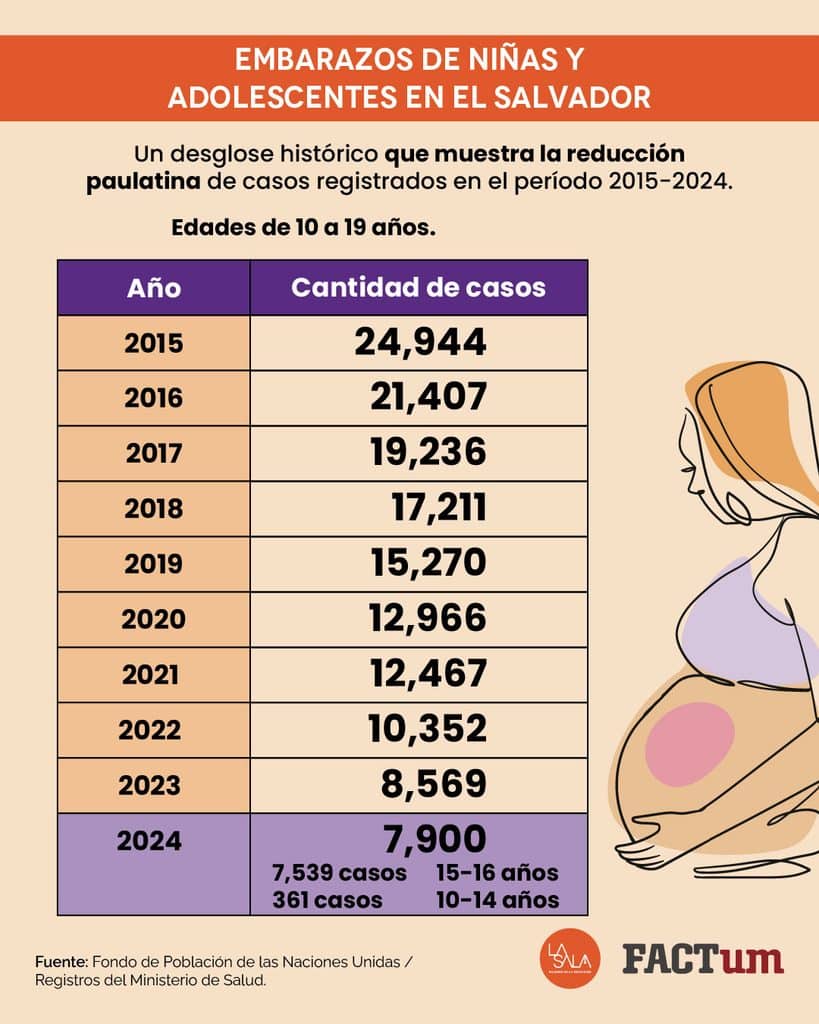
The United Nations Population Fund (UNFPA) reports a decrease in forced pregnancies in girls since 2015; however, El Salvador has not been able to meet the goal of reaching “zero pregnancies” in girls and adolescents in a context of weakening institutional protection.
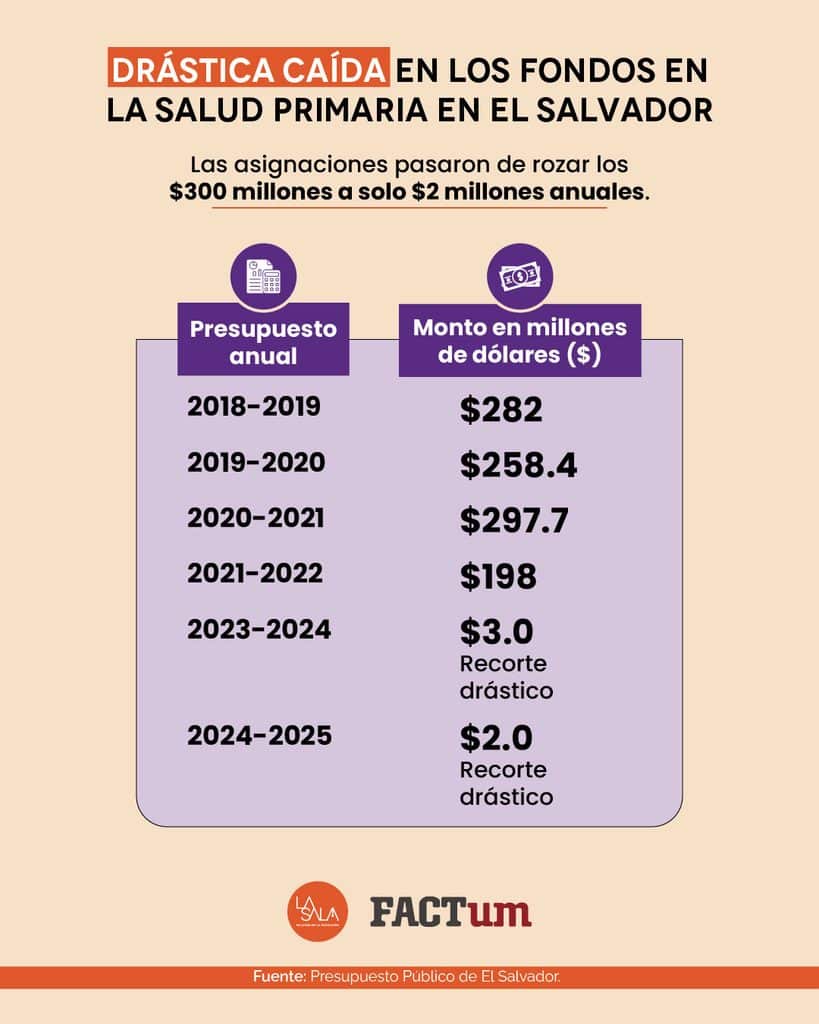
The collapse of the community health budget since 2021 has left girls at risk of forced pregnancies. A reduction of at least $295.73 million between 2018 and 2024 is reported in the primary care level of the Salvadoran public health system, which provides coverage to communities and prevents forced pregnancies in girls between the ages of 10 and 14, according to data from the Ministry of Health’s (MINSAL) annual reports.
A clear example of the government’s impact on care for vulnerable populations is the drastic budget cut in health: the allocation for primary care services and investment development was reduced from $297.73 million in 2020 to just $2 million in 2024.
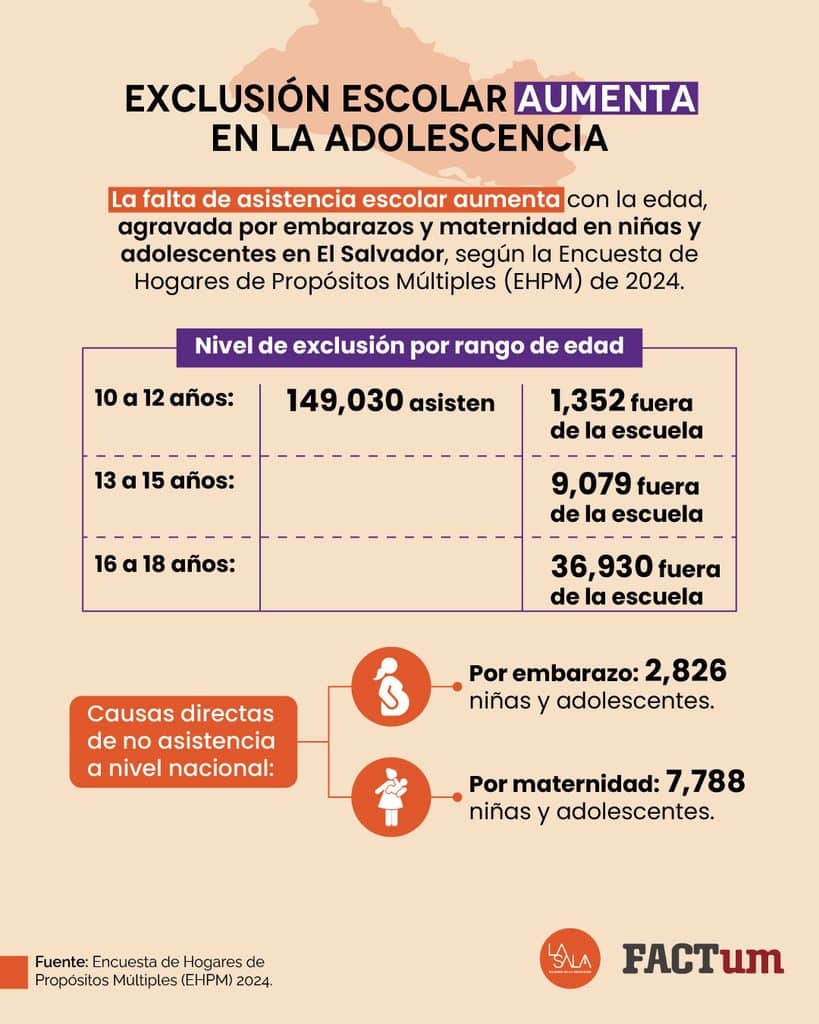
While Community Family Health Teams, staffed by health personnel who provided sex education in communities, have been affected, girls continue to be forced into motherhood. In 2024 alone, 7,900 pregnancies were recorded among girls and adolescents between the ages of 10 and 19, according to UNFPA data.
The life plans of girls and adolescents are cut short by this situation. After becoming pregnant, they abandon their daily lives and dedicate themselves to caregiving tasks at home. Of the 47,361 girls and adolescents who did not attend school in 2024, 7,788 did not attend due to motherhood and 2,826 due to pregnancy.
In the eyes of Salvadoran feminist activist and human rights defender Morena Herrera, a power dynamic or a relationship of domination is always present in the pregnancies of girls and adolescents. Therefore, according to Herrera, it is important that these pregnancies be recognized as acts of violence against them, and that it be acknowledged that they were assaulted.
“We can call it rape, harassment, extortion, but there is always a power dynamic, a relationship of domination. Therefore, the lack of recognition of forced or imposed pregnancy is a denial of that violent and dominant relationship and is a way of ignoring the status of the assaulted, the victimized, that girls and adolescents have,” the feminist activist said.
This invisibility also occurs within the state’s own records. Knowing how many girls are victims of sexual violence, how many become pregnant as a result of these attacks, and what happens to their perpetrators is essential for designing prevention and protection policies. However, the available data does not allow for a complete reconstruction of this trajectory.
There is no evidence linking the number of pregnancies among Salvadoran girls resulting from sexual assault to the number of pregnancies, as the Attorney General’s Office does not document these cases in its annual reports. On average, between 2,700 and 3,018 sexual assaults have been reported in El Salvador over the past six years, according to statistics compiled by the Police and the Institute of Legal Medicine.
It is not known whether the victims underwent psychological or medical treatment to overcome their trauma or prevent sexually transmitted diseases.
The cases were not broken down by age, sex, region, or municipality where they occurred. According to statistical experts who preferred to remain anonymous for their safety, this generalization renders the victims invisible and contributes to impunity.
The Attorney General’s records also do not specify how many were found guilty or whether the defendants are still undergoing legal proceedings. The Attorney General’s Office did not respond to public information requests by the time of publication.
El Salvador has reduced pregnancies among girls and adolescents, but thousands still drop out of school due to pregnancy or motherhood, and sexual assaults persist. In this context, naming them goes beyond language. Without information, prevention, and statistics that allow us to understand the scale of the violence they face, Salvadoran girls and adolescents remain victims; they simply become harder to see.
Interviews and information requests were sent to the communications offices of the Ministries of Education and Health between August and September 2026; however, no response was received by the time of publication. The Presidential Press Office also did not respond to inquiries made by Factum Magazine.
*This story was produced as part of a La Sala: Mujeres en la Redacción journalism production grant, funded by Vikes, the Foundation for Media and Development, an initiative that seeks to strengthen independent, critical and investigative journalism—as well as to promote the participation, leadership and projection of women journalists—through influential and impactful actions that contribute to making their voices visible and positioning them as benchmarks of journalism, research and public opinion.
Author
Related Articles
After 17 years of waiting, Guatemala still fails to protect its girls
While a presidential veto and the inaction of the Constitutional Court keep a reform to the age of consent frozen, this investigation reveals how Guatemala maintains a legal vacuum that leaves thousands of survivors of sexual violence and forced pregnancies unprotected.

The gaps in Costa Rica’s sex education—and what they mean for teen pregnancies
We examine the achievements and limitations of the sex education implemented in Costa Rica. Produced as part of the “La Sala: mujeres en la redacción” journalism grant.

The Health Protocol fails survivors of sexual violence in Honduras
While the state promises medical care and emergency contraception after sexual assault, impunity and neglect prevail in rural Honduras. This investigation by Radio Progreso and La Sala, Mujeres en la Redacción, reveals how the slow implementation of the public health protocol perpetuates the revictimization of girls and denies their right to justice.