After 17 years of waiting, Guatemala still fails to protect its girls
While a presidential veto and the inaction of the Constitutional Court keep a reform to the age of consent frozen, this investigation reveals how Guatemala maintains a legal vacuum that leaves thousands of survivors of sexual violence and forced pregnancies unprotected.
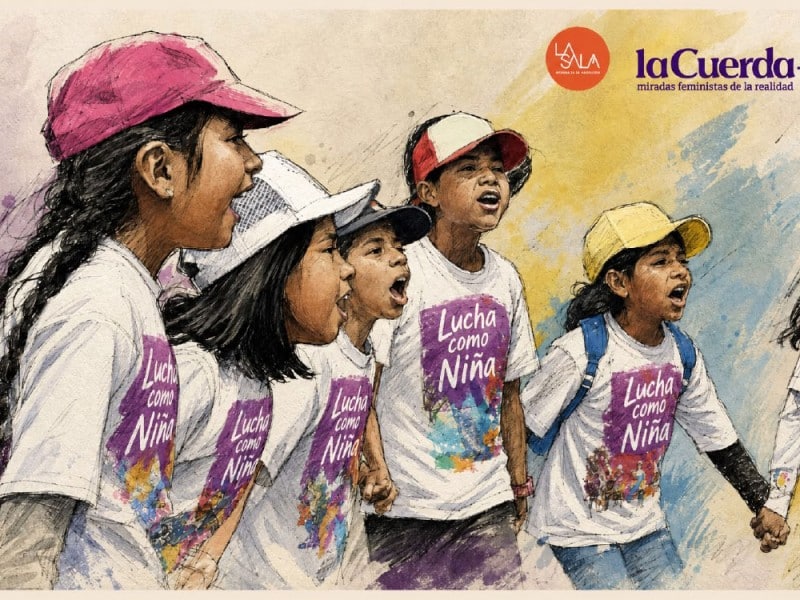
Fernanda was 14 years old the day she gave birth in a hospital in Cobán, in northern Guatemala. When the man who had impregnated her arrived at the maternity ward demanding to take Fernanda and the baby back home, she hid in the hallways. There were no blows to examine or bruises to photograph for a forensic report—just a girl looking for a place where she wouldn’t be found.
“The abuser feels entitled to his daughter… as if she were his property,” a member of a civil society organization who accompanied Fernanda told Human Rights Watch. No one forced a door that night. No one had to: legally, nothing that happened qualified as a flagrant crime, because in Guatemala, 14 is the age at which a girl can “consent.” The mere absence of a “no” that is shouted or filmed is enough for the word “abuse” to dissolve into the much more convenient category for the system of “consensual relationship.”
This is not a bureaucratic oversight, but a legislative decision Guatemala made in 2009 that, seventeen years later, remains unresolved. In April of this year, something seemed to shift: Congress voted to raise the age of consent from 14 to 18. However, the decree was flawed, and President Bernardo Arévalo vetoed it. He argued that it violated the principles of legality and harm, and that the ambiguous exception for adolescents could end up criminalizing consensual relationships between peers. The case is now before the Constitutional Court, which has yet to issue a ruling.
Fernanda, if she were 14 years old today, would still be unprotected.
Seventeen years of a legal loophole
The divide has a date of birth. In 2009, Congress passed the Law Against Sexual Violence, Exploitation, and Trafficking in Persons (Decree 9-2009), whose stated objective was “to prevent, repress, punish, and eradicate sexual violence, exploitation, and trafficking in persons, as well as to protect their victims.” However, that same reform set the minimum age of sexual consent at 14. That’s where the divide began. (That year, incest and statutory rape ceased to be separate offenses and were prosecuted as rape, with higher penalties; that part wasn’t a setback, but the new age threshold was.) In practice, an adult could have sexual relations with a 14-year-old girl without the age difference, in itself, constituting a crime.
Six years later, in 2015, Congress outlawed child marriage but left the age of consent untouched. This created a textbook contradiction: a teenager couldn’t get married, but the law still assumed that, from the age of 14, she could “consent” to an adult. A 60-year-old assailant needed only the phrase “she didn’t say no” to legitimize an assault. “That pattern was very common,” confirms criminal lawyer Montserrat Hidalgo of the Survivors Foundation.
In 2024, the UN Committee on the Rights of the Child warned that Guatemala maintained a “legal gap” regarding sexual relations between adults and adolescents. The figures support this warning: between 2018 and 2024, the National Registry of Persons (RENAP) recorded 14,696 births to girls aged 14 or younger, mostly resulting from forced pregnancies. During that same period, girls accounted for 88% of the evaluations for sexual violence or pregnancy in girls under 14 conducted by the National Institute of Forensic Sciences (INACIF). The same HRW report documents the other side of that figure: between January 2018 and October 2023, only 136 indictments were issued and 102 convictions were handed down nationwide for cases involving girls under 14. For every conviction, there were more than one hundred births.
“Sexual relations between adults and minors are not normal. It is our obligation to prevent them,” says Raúl Barrera, the congressman who promoted initiative 6430, the Law to Prevent Child Sexual Abuse.
A law that faced an uphill battle
In Guatemala, no law changes simply because someone feels like it. It changes only through persistent pressure. On Aug. 6, 2024, Barrera—along with COINCIDIR, the National Association Against Child Abuse (CONACMI), JoLu de Guatemala, the Academy of Higher Legal Studies, and the Archdiocese of Guatemala—presented Initiative 6430 at a press conference. She supported it with a statistic from RENAP: approximately 30,000 births are registered in the country each year where the mother is a minor, and in seven out of ten cases, the girl’s partner is an adult man.
The initiative reached the Legislative Directorate on Aug. 8. On the 27th, the plenary session referred it to the Committee on Children and Families. Months of technical meetings with the justice sector, workshops in various departments, and dialogue with organizations such as Tierra Viva and La Alianza followed, until the political blocs began introducing objections and modifications. In March 2025, faced with concerns from other committee members, Barrera agreed to return the bill for review rather than force a vote that would jeopardize months of work. The reform finally went through three debates: on April 14, 2026, Congress approved Decree 10-2026 with 126 votes in favor, 4 against, 14 absences, and 16 leaves of absence.
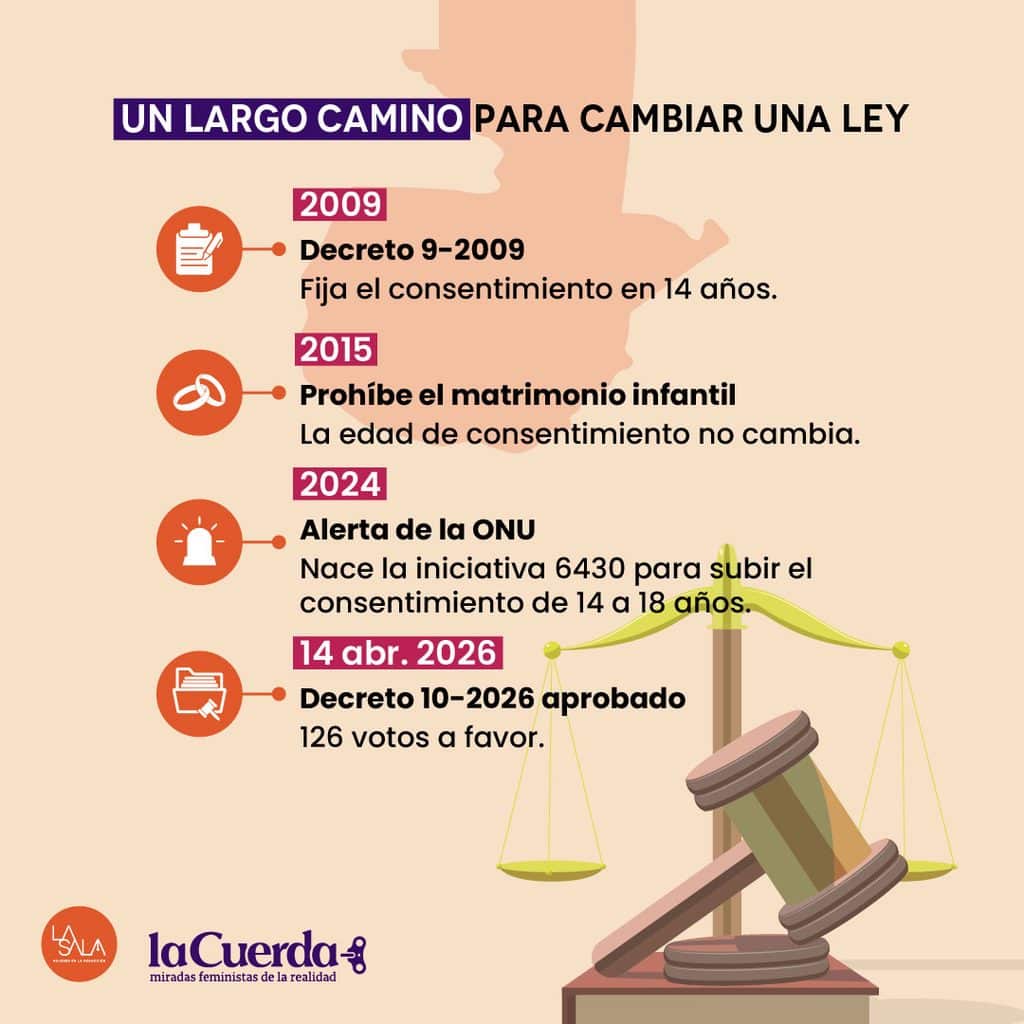
This timeline shows the path towards changing the law in Guatemala, starting in 2009, when decree 9-2009 set the age of consent at 14; 2015, when child marriage was prohibited, but the age of consent did not change; 2024, when Initiative 6430 sought to raise the age of consent from 14 to 18; and April 14th, 2026, when Decree 10-2026 was approved with 126 votes in favor.
What the law changed, and what it left unresolved
The decree expressly prohibited sexual relations between adults and minors under 18, even with “consent.” It established penalties of 10 to 14 years without parole when the victim was a minor, and stipulated that it is these sexual relations are still a crime when the victim was under 14 or had a volitional or cognitive disability, even without violence. Sexual assault that did not constitute rape was punishable, in these cases, by 7 to 10 years without parole; for adult victims, the penalties increased to 8 to 12 years.
But upon reading the final draft, several organizations consulted during the process recognized little of what they had proposed. Ambiguous wording opened the door to criminalizing teenage dating and left gray areas in the protection of girls with disabilities. The law that promised to close one loophole risked creating others.
On May 6, 2026, Arévalo returned the decree to Congress. The Executive Branch argued that the reform violated the criminal law principles of legality and harm, and that the ambiguity of the exception for adolescents could lead judges to criminalize consensual relationships between peers. To support its position, it invoked a general comment from the UN Committee on the Rights of the Child: Guatemala must address adolescent sexual development from a comprehensive, non-punitive health perspective.
On May 12, Congress referred the veto to the Constitutional Court, with 102 votes in favor and 4 against. It remains there, neither in effect nor shelved. While the Court has not yet ruled, there is no complete legal vacuum. Decree 9-2009, which set the age of consent at 14 and which this reform sought to replace, remains in force, but there is no date set for that to change. “There is no estimated timeframe,” Congressman Raúl Barrera confirmed to this reporting team. “We are waiting.”
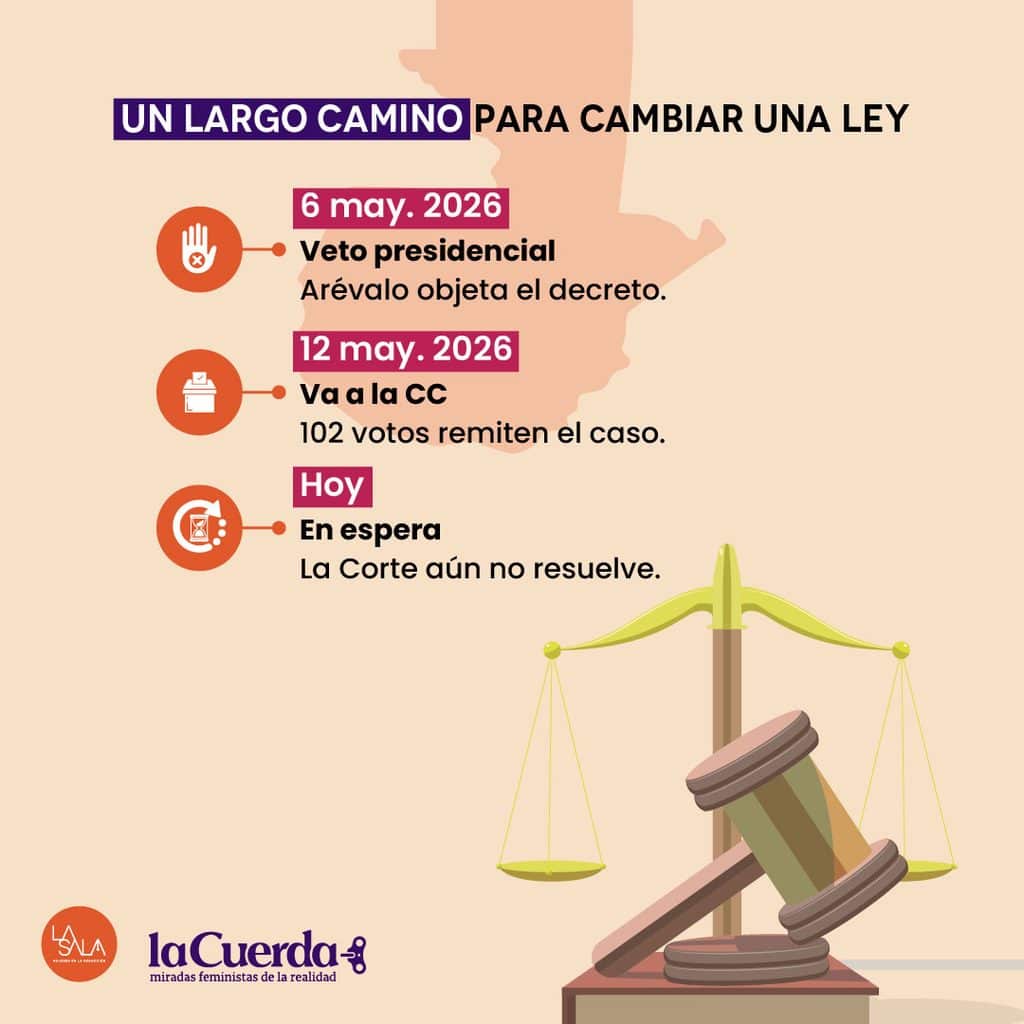
On May 6th, 2026, President Arévalo vetoed the decree. On May 12th, Congress sent the decree to the Constitutional Court for review, with 102 legislators in favor of this step. At the time of publication, it’s a waiting game. The Court has not yet ruled on the matter.
Who writes the law, and who lives by it
For several of the organizations that promoted the initiative, the reform ended up weakened, “toothless,” a law that “condemns and criminalizes the human right to healthy sexuality,” in the words of Carolina Escobar, director of La Alianza, which welcomes girls and adolescents who are survivors of violence.
Escobar defends the original proposal: it would have classified sexual relations between an adult and any minor as rape, without the possibility of a commuted sentence, and it originated from focus groups that listened to the demands of young people from La Alianza and other organizations. What changed, he says, was what happened afterward: the sponsoring congressman had to negotiate with conservative sectors, including the Association Family Matters (AFI), a pro-life platform. An openDemocracy investigation documented in 2024 that AFI, founded in 2013 by people linked to the Catholic prelature Opus Dei, became one of the most influential advocacy organizations in Guatemala, with a presence in Congress, the government, and the Inter-American human rights system.
According to Escobar—whose account of AFI’s influence on the final drafting could not be independently verified by this reporting team, beyond what openDemocracy has documented—that organization, AFI, had the final say on key parts of the initiative.
“When they prioritized the opinions of conservative sectors over those of us with field experience working with children and adolescents, that’s when things went wrong,” she says.
AFI’s executive director, Ligia Briz, did not directly address the accusation regarding her organization’s influence on the final text of the decree. She did, however, question the presidential veto, calling it “a serious setback for the protection of children and adolescents in Guatemala” and dismissing Arévalo’s invocation of international conventions as a mere “excuse.”
The result, Escobar says, has several flaws. One is that the age of consent was raised to 18 years tacitly and not explicitly, which leaves room for judicial arbitrariness. In addition, the minimum threshold of what constitutes sexual assault was not defined.
“How could we leave such important decisions, which should be properly regulated, in the hands of a single person?” asks Escobar. No mechanism was considered for minimal age differences between adolescents, which could criminalize healthy peer relationships. Finally, the law “minorized” women and girls with disabilities, treating them as if they could not decide for themselves.
Those who should have the most say on a law that regulates their own bodies are the girls and teenagers themselves. The girls from COINCIDIR participated in the consultations and were with Barrera on the day of the presentation. Their assessment is neither cynical nor naive: it comes from knowing the problem first hand, and also its partial solutions.
“This law is essential because we felt it was a change for our community and the entire country,” says 16-year-old María. But María and Diana*, both 14, also point out the flaws and agree with the arguments for the presidential veto. Peer relationships shouldn’t be treated the same as relationships with adults, they say. And the law should analyze ages and situations on a case-by-case basis, not with a single standard.
Attorney Montserrat Hidalgo agrees with this overall assessment, but offers a more nuanced take. Raising the age of consent, she says, is “a much-needed and logical step forward” that brings Guatemala’s laws in line with those of other countries. She particularly welcomes the inclusion of the term “abuse of power” to describe the relationship of power and control exerted by an aggressor, because it frees those litigating these cases from constantly justifying this asymmetry.
“As long as it’s not named, it doesn’t exist, and once it’s named, it can be properly recognized,” she says.
But her support has a limit, the same one that led to the veto: the paragraph that penalizes consensual relationships between adolescents of similar ages seems ambiguous and excessive to her.
“You can’t criminalize an adolescent for their integral development,” she says. And she gets to the heart of the problem: “How easy it is to come along and say: ‘it’s prohibited for all adolescents. So we might as well punish them and not bother with creating education and prevention policies.’”
What Central America has already resolved
Until this reform, Guatemala had one of the lowest consent thresholds in the region. El Salvador, Honduras, Nicaragua, Costa Rica, and Panama already have 18 as the age of full protection, with aggravated penalties for minors under 14. All are also bound by the Convention on the Prevention and Elimination of the Commercial Sexual Exploitation of Minors in Central America, the regional framework that explains why the Guatemalan reform ultimately sought to bring Guatemala up to date.
What is remarkable is that Guatemala is the only country in the region where a reform of this kind was approved by the legislature and then blocked by the executive branch. Costa Rica and Panama implemented similar changes without this institutional clash; Honduras is moving forward with a more collaborative process between civil society and Congress. This suggests that the obstacle in Guatemala was not a lack of legislative consensus—the 126 votes in favor demonstrate this—but rather, specifically, the relationship between Congress and the executive branch regarding the legal drafting of the text.
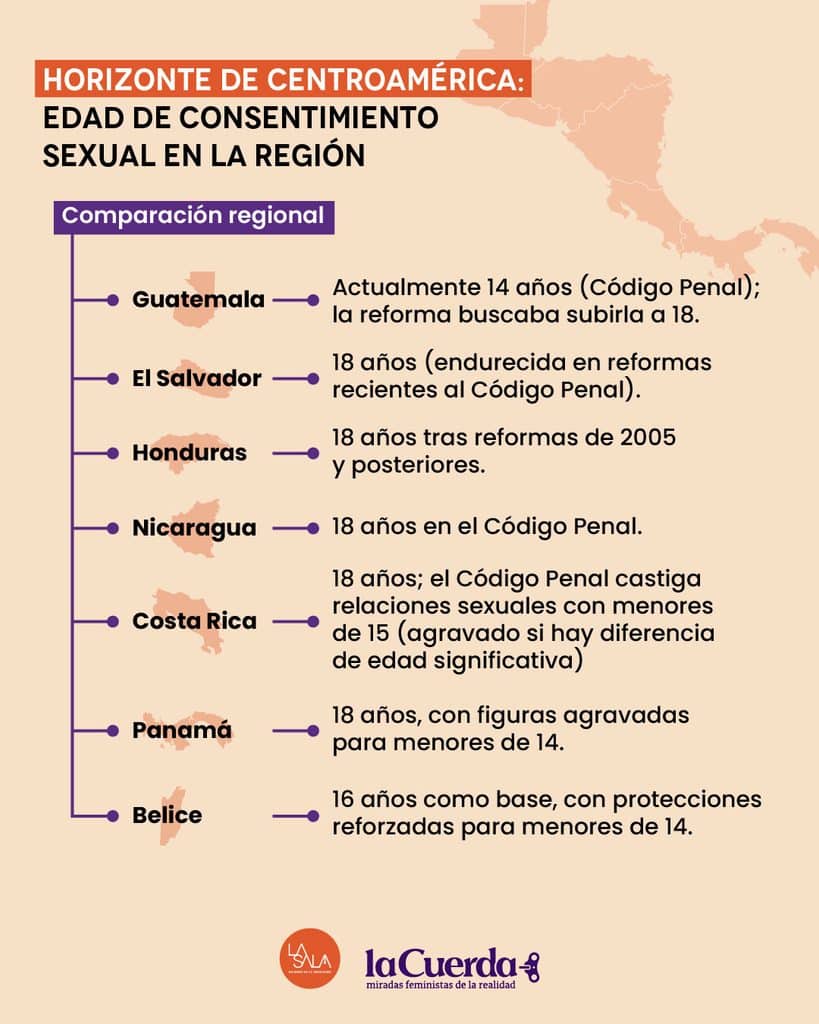
This graphic shows the age of consent throughout Central America. As we’ve seen in this story, Guatemala remains at 14; Belize is at 16; the remaining countries of the region are at 18, with various levels of protection.
Violence with a surname
National figures mask something that disaggregated data reveals: this violence does not affect everyone equally. According to monitoring by the Observatory on Sexual and Reproductive Health (OSAR), between January and July 2016, Guatemala registered 1,294 pregnancies in girls aged 10 to 14; 634 of these girls were Indigenous. The territorial concentration is equally clear: Huehuetenango leads with 198 cases, followed by Alta Verapaz with 185, Quiché with 132, and Petén with 115—the same departments that suffer from the worst indicators of poverty, rurality, and limited access to health and education in the country.
Neither RENAP nor INACIF, the two sources that provide the national figures for this report, break down their data by department or town. It is OSAR, a civil society organization, that maintains this monitoring. This omission, in itself, speaks volumes: the State measures sexual violence against girls as if it were a uniform phenomenon, when the evidence on the ground shows that it hits hardest precisely where state protection is least effective.
What the law cannot fix on its own
Changing the law, all sources for this report agree, is not enough if the system around it continues to fail. Cases that are not reported and, when they are reported, run into judicial delays, insufficient medico-legal assessments and a lack of resources.
There’s a quieter, earlier void: the lack of comprehensive sex education.
“My sister got pregnant at 14. She knew nothing about menstruation,” says María. She remembers that when she herself started menstruating, she had basic questions: what to take, when she would bleed. She didn’t know there was a real chance of getting pregnant from having sex. This lack of information led her to give talks to other girls; one of them once asked her, “María, why do we bleed?”
Diana had her first period at age eight and describes it as something inexplicable that frightened her because she didn’t know what to do. At home, she says, it’s a topic discussed in hushed tones: “Not right now, because there are men around,” or it’s simply not discussed at all.
Regarding her sister’s pregnancy, María isn’t just asking for information; she’s asking for empathy.
“Maybe she made a mistake, but people come and start criticizing,” she says. “The community should also empathize, analyze the situation, and teach her a lesson: to talk about these issues more openly.”
The other shadow zone: the aggressors
There’s a question that’s almost never asked in this debate. What happens to men who abuse? Girls are told to report it. Men are almost never told that pedophilia is a disorder that requires clinical treatment, not just condemnation.
There are few organizations in Guatemala that work with children, adolescents, and young adults on new masculinities. Within the prison system, there are no rehabilitation programs for these types of offenders.
“What you usually hear is that they never change,” says Escobar.
This absence contrasts with what we already knew about the profile of these aggressors. Sonia Ivonne Recinos del Cid’s 2012 master’s thesis at the University of Costa Rica and National University, conducted with eight inmates at the Preventive Center in Zone 18, analyzed the construction of masculinity in adult sex offenders from a feminist and qualitative perspective. She found that most grew up in families with traditional and stereotypical upbringing, marked by physical punishment and domestic violence, and with difficulty establishing bonds of trust and empathy.
They associated sexuality with power, domination, and control. Their sex lives were marked, in several cases, by the use of prostitution as a virility ritual, extreme homophobia, and habitual pornography consumption. And they maintained the usual cognitive distortions: blaming the victim, claiming provocation, and assuming that women and children “enjoy” being subjugated.
Recinos concluded that hegemonic masculinity and its mandates of domination are the origin of sexual violence, and that deconstructing it requires profound cultural and educational changes, not just penal ones.
Hegemonic masculinity and political power
Behind the case that awaits review today at the Constitutional Court lies a question more uncomfortable than any legal technicality. Does Congress really care about girls, or is it more concerned with not upsetting the sectors that negotiate the final text of the laws that claim to protect them?
The pattern repeats itself with a regularity that can no longer be called coincidence: a law drafted with technical and community participation, then rewritten under pressure from conservative actors. This is what Escobar and Hidalgo describe regarding Decree 10-2026, but it is also the pattern that permeates schools, where comprehensive sex education remains a major unresolved issue; families, where talking about menstruation or abuse happens “in hushed tones”; and the justice system, where the burden of proving abuse almost always falls on the girl.
As long as those three spheres—Congress, school, and justice—do not move in unison, no penal reform, no matter how many votes it gathers, will completely close the rift that Guatemala opened in 2009.
The entire country now awaits the opinion of nine magistrates. Fernanda, however, can no longer wait. She gave birth some time ago in a Cobán hospital, without anyone filing a forensic report. The question this investigation raises is not legal; it is simpler and more urgent: while the case remains in a drawer at the Constitutional Court, what will happen to the unprotected girls?
*This story was produced as part of a La Sala: Mujeres en la Redacción journalism production grant, funded by Vikes, the Foundation for Media and Development, an initiative that seeks to strengthen independent, critical and investigative journalism—as well as to promote the participation, leadership and projection of women journalists—through influential and impactful actions that contribute to making their voices visible and positioning them as benchmarks of journalism, research and public opinion.
Author

Related Articles

Introducing ‘Girl, Interrupted’
Journalists unite across borders to report on women and girls in Central America, and their reproductive rights

LatAm SoJo Fund Fellowship story wins Silvia Galvis Journalism Award in Colombia
LatAm SoJo Fund Fellow Jose Ignacio Estupiñán Martínez won the Silvia Galvis Journalism Award in Colombia this week.
The fishing life in Tárcoles, amidst nets and tourists
Families in Tárcoles, on Costa Rica’s Central Pacific coast, have relied on small scale fishing for years—but this way of life is increasingly precarious. An alternative, fishing tours, has brought new opportunities.