The school that opened the sport fishing industry to women
In the world of sport fishing, women participate in pre-fishing activities (such as preparing food for the crews) and post-fishing activities (filleting, selling the catch, and cooking). A school that started in Guanacaste and is now located in Puntarenas seeks to integrate women into the workforce on tourist and sport fishing vessels.
In the world of sport fishing, women participate in pre-fishing activities such as preparing food for the crews, and post-fishing activities (filleting, selling the catch, and cooking). A school that started in Guanacaste and is now located in Puntarenas seeks to integrate women into the workforce on tourist and sport fishing vessels.
Noelia created this story with a grant from the Latin American Solutions Journalism Fund, an initiative of El Colectivo 506. The grant was made possible by a donation from the Costa Rican Fishing Federation (FECOP) for solutions journalism with editorial independence on community fishing issues. FECOP supports the initiative as part of its “Participatory Fishing” project, in partnership with the U.S. Embassy in Costa Rica. The story was originally published in La Voz de Guancaste on May 22, 2026 and re-published at El Colectivo 506.

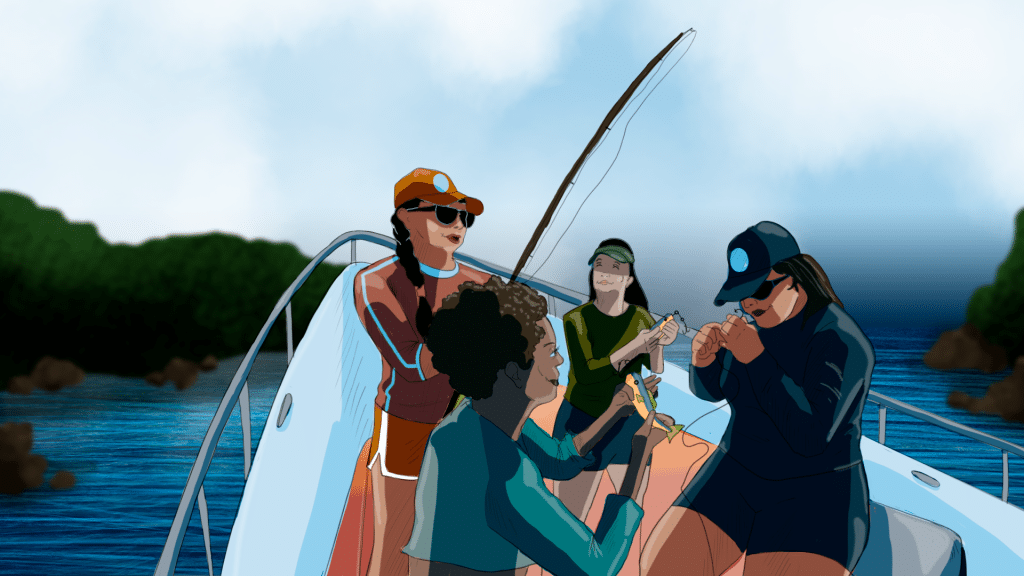
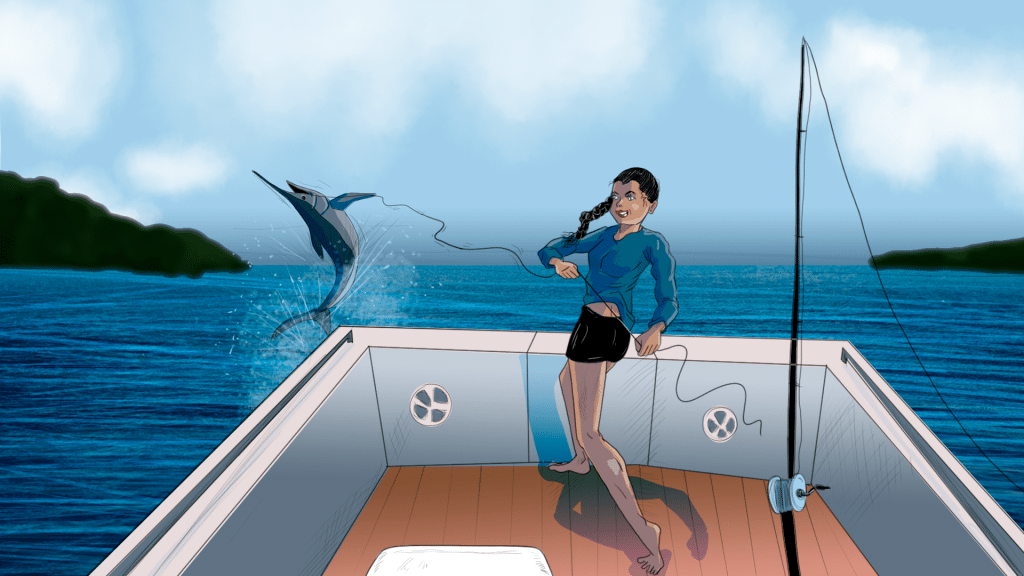
Léonie Barry pulls hard on the fishing line held by another woman on the boat. She twists her hands and pulls as her long hair, tied in a ponytail, dances down her back with every tug. Soon, the huge fish they’re catching will be in her hands. It’s an everyday scene on Léonie’s social media, as she now competes in international sport fishing tournaments thanks to the talent nurtured in Guanacaste that opened the doors to the sea for her.
“Love to see a girl leading! 🔥🔥,” someone comments on another video.
The comment might seem commonplace, but it sums up exactly what seemed unthinkable a few years ago for women like her: thriving in an industry where men almost always held the helm.
Sport and recreational fishing—in Costa Rica and around the world—has historically been a male-dominated field. But since 2019, the Women’s Nautical School—a program founded between the Guanacaste communities of El Coco and Flamingo—has been challenging the male-dominated nature of the sector in this country.
From improvisation to consolidation
The School came about thanks to an idea conceived by Jokselin López, a young fisherwoman and community leader on the Guanacaste coast.
“I saw the need in the area and how we were lacking women on board. I simply said, ‘Let’s get to work,’ called FECOP, and all the connections started to come together and develop,” López recounts in a video produced by the Costa Rican Fishing Federation (FECOP), a nonprofit organization that promotes sustainable sport and tourism fishing through science and education, and which has led this initiative.
Jokselin’s goal was to eradicate the structural inequality that forces women in the province to accept low-paying jobs, while demonstrating that female service in sport fishing adds value in customer service, she explained to La Voz.
There was no established methodology or significant funding, but they were clear that the goal was to teach coastal women sport fishing and tourism skills and open up job opportunities for them in that sector.
“They are women of the sea; the thing is, life never gave them the option, and they never saw that there was a place for them within this subsector,” says Damián Martínez, director of Conservation and Public Policy at FECOP.
He also notes that in a survey FECOP conducted in Costa Rica involving some 1,200 vessels, they found only one woman working in the field.
The first-generation classes were organized with the support of borrowed boats, local volunteers, fishermen willing to share their knowledge, and others in the sector who believed it was worth a try.
In Costa Rica, women’s participation in marine and coastal sectors remains largely invisible. They remain on the margins of a sector that generates between $500 million and $520 million annually for Costa Rica and attracts visitors who spend an average of more than $7,500 during their trips, according to data included in the Guide to Best Practices for Recreational and Sport Fishing in Costa Rica, a document published in 2023 by FECOP and the Marviva Foundation.
Furthermore, a recent assessment on gender and marine resources in the Pacific notes that even official statistics have significant gaps when it comes to gauging how many women actually work in fishing and tourism.
Many participate in pre-fishing activities (such as preparing food for crews, cleaning and organizing equipment) and post-fishing activities (filleting, selling products, cooking), but their work is rarely recognized in licenses, censuses, or public policies.
Knots, passion, and barriers
The first two iterations of the Women’s Nautical School took place in Guanacaste, both between Flamingo and El Coco. The curriculum has gradually expanded to include training on basic knots, equipment use, casting techniques, and boat maintenance.
It is a practical training program lasting approximately three months—though the duration may vary depending on the group—taught in a peer-to-peer format by captains, sailors, fishers, and others connected to the sector, who currently receive a symbolic financial stipend for their time.
Rather than a fixed schedule, the training is organized around hours of instruction and hands-on experience at sea, with classes held once or twice a week and practical sessions on boats. In each cohort, FECOP selects approximately 15 women who must be able to travel to classes on their own.
According to Henry Marín, Director of Strategy and Projects at FECOP, several women from both groups have successfully entered the workforce on tourist and sport fishing vessels. Léonie Barry is one of them. She is a 22-year-old resident of Brasilito, who, after finishing high school, began working on catamarans and learned “the basics of the sea,” she says.
“At Marina Flamingo, I’d see fishermen and wonder, ‘What’s that like?’” she recalls, until friends and acquaintances began teaching her. “The Women’s Nautical School crossed my path; it helped me get started, and that’s where I began to make more contacts.”
Barry was part of the first generations of women who put to the test an idea that was then just beginning to take shape. In those early years, the school operated without clear monitoring mechanisms to measure how much the students were learning or how they were applying that knowledge, explains Marín.
Even today, the program lacks detailed documentation on the employment status of its graduates and on how the training has impacted their job opportunities and income.
Furthermore, according to Yokselin López, the project’s founder, she left the school after working as a volunteer and expressing her need and desire for compensation.
“I worked for free for a long time, as a volunteer for a great idea that likely helped more than one person get a raise […] When I started thinking that I needed to make money, that I needed a salary… that’s when it all fell apart,” she says.
What does seem clear is the growing interest among many women in joining the sector. In the school’s social media posts, it is common to find comments from women asking how to participate or expressing their desire to be part of the program.
After running two cohorts in Guanacaste, each with 15 students but fewer graduates due to dropouts, the school moved to Quepos.
There, Josabeth González—a former student—now instructs the new students on their first trips out to sea.
The expansion, however, has not yet reached the Costa Rican Caribbean. According to Martínez, differences in infrastructure and fishing dynamics in communities without a marina require careful adaptation of the curriculum and teaching methodology.
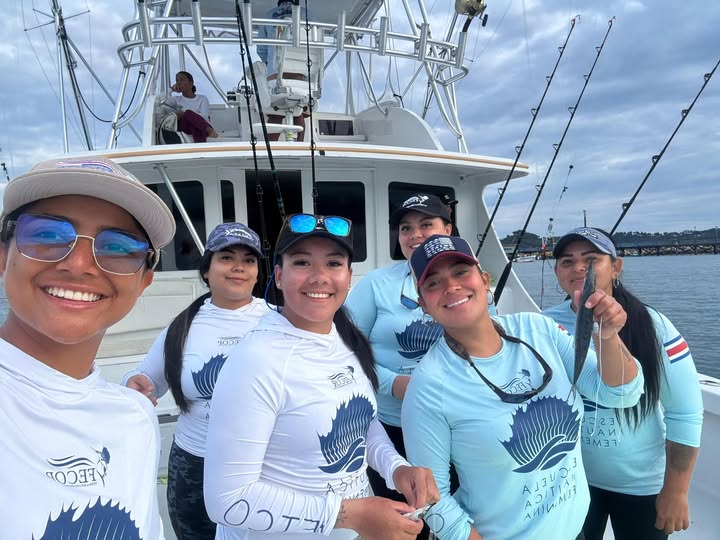
Funding from the European Union made it possible to create teaching manuals and monitoring tools to formalize the course.
Funding from the European Union made it possible to create teaching manuals and monitoring tools to formalize the course.
Even today, participants face resistance from men in the sector, who have questioned why there was a program exclusively for women.
In part because of this, the project changed its name. It was initially called the Escuela Náutica Femenina, and is now called the Escuela para Náuticas—a relatively small linguistic shift, but one that helps support FECOP’s goal to eventually open a “Escuela para Náuticos” for men in the sector.
“Some men resented the fact that it was only for women. There are people along the coast who still don’t understand that these women weren’t on equal footing with them,” says Martínez, the conservation director.
Closing gaps as a collective effort
As the initiative matures, one challenge persists: the fragility of sustaining it.
“If FECOP stops sponsoring it today, the project falls apart […] we’ve thought about trying to establish some financial mechanism that we can fund, one that has a small staff and can stand on its own,” explains Damián Martínez.
About 80% of its funding comes from the FECOP budget, Martínez notes. The rest comes from partnerships, aid, and one-off grants, but there is still no robust public policy to ensure sustainability, nor a partnership with government agencies as counterparts in this effort to combat social and gender inequalities.
This means that much of the social transformation impacting these coastal communities continues to depend on private funding and international cooperation. “We haven’t been able to identify the right partners,” he says, and reiterates: “If FECOP stops funding us, the whole thing falls apart.”
Those behind the school say they have tried to get public institutions such as the National Institute of Learning (INA) to take on part of the mandatory basic technical training required to legally go to sea and to receive a degree that is truly accredited, because the one FECOP provides is symbolic. But these efforts have not borne fruit.
Even so, the project continues with the aim of providing women with new opportunities along the coast. They are currently moving forward with the organization to launch a new cohort in Paquera, a district on the Nicoya Peninsula in Puntarenas.
With every woman the program trains—or even with those who simply dare to imagine themselves working in the sector after seeing its graduates in action—change begins to become more visible on the country’s docks and boats.
Even Jokselin López, who spearheaded the project’s first generations in Guanacaste, dreams of launching her own initiative linked to the sea and women’s empowerment.
“I think that at some point I’ll fulfill my dream of having—not a school like that, so big, but I do plan to set up a camping project,” she says.
Although they remain a minority, face resistance, and depend on financially fragile projects, every woman who joins a crew is gradually transforming the coastal landscape. The sea is slowly ceasing to be a territory reserved solely for men.
Author
Related Articles
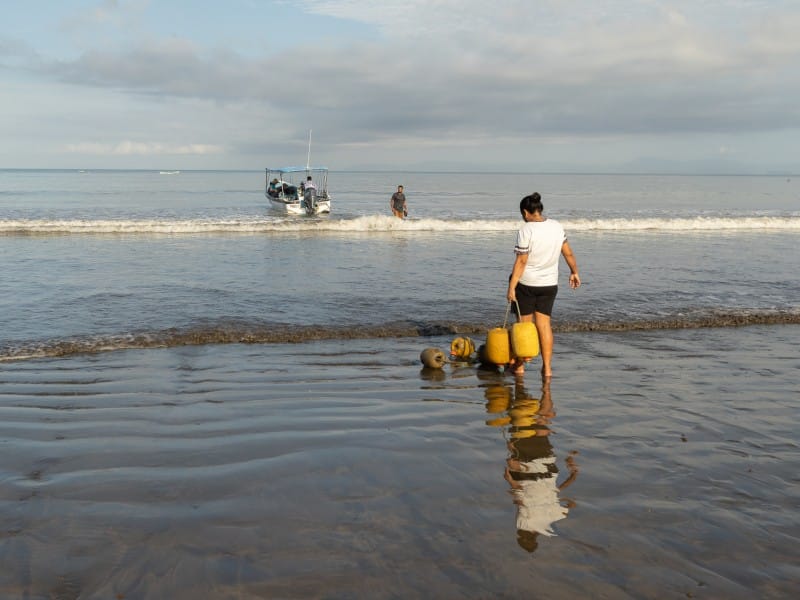
The fishing life in Tárcoles, amidst nets and tourists
Families in Tárcoles, on Costa Rica’s Central Pacific coast, have relied on small scale fishing for years—but this way of life is increasingly precarious. An alternative, fishing tours, has brought new opportunities.
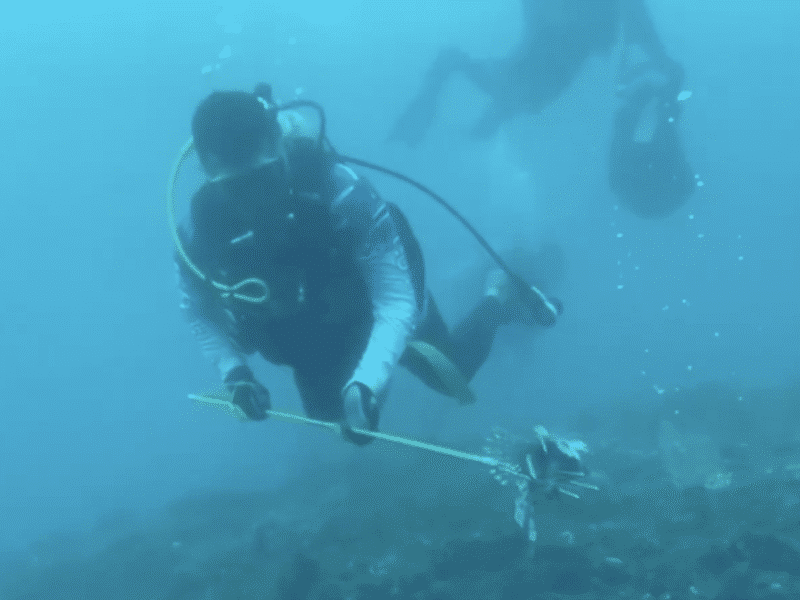
Threat and opportunity: the lionfish in the Southern Caribbean Coast
The lionfish is an invasive species that is damaging the coral reefs along Costa Rica’s southern Caribbean coast. Local fishermen hold lionfish fishing tournaments to try to reduce the population.
The multifaceted world of sport and tourist fishing in Costa Rica’s Central and Southern Pacific
Tourism initiatives centered on sport fishing require much more than a healthy ocean. It depends on trained personnel both on and off the water who can meet ever client’s needs. In Costa Rica’s Central and Southern Pacific, this is what’s being promoted and protected.
