


Every day in the Colibrí del Sol reserve, two women protect the Urrao magnolia, an endangered tree, from indiscriminate logging and agricultural expansion that threaten its natural habitat in Antioquia. Journalists Fabián Uribe Betancur and Valentina Pineda Lamus tell their story in this report, produced with the support of the Earth Journalism Network through the Latin American Solutions Journalism Fund, an initiative of El Colectivo 506. It was originally published in Breve Medio on Nov. 24, 2025, and has been adapted and translated by El Colectivo 506 for co-publication. ChatGPT was used to create the first draft of the translation.

At the Colibrí del Sol reserve, two women are conserving the Urrao magnolia almanegra, or dark-soul magnolia, an endangered tree. Each seedling is cared for with patience and skill; it must survive pests and adverse weather conditions. Every surviving sprout is a symbol of resistance against the indiscriminate logging and agricultural expansion that threaten its habitat in Urrao, Antioquia. This initiative is part of the Proaves Foundation’s Almanegra project, which protects fifteen other species in different reserves across the country.
Where the almanegra grows
A dense fog drifts stealthily across the mountains of the Penderisco Valley. It is early; the sun has not yet dared to break through the veil of the sky. Amid the scattered trills of birds, the cold slips across the peasants’ ponchos like a curious shadow, sniffing at the drowsy bodies waiting at the edge of the main park in the municipality of Urrao. Men and women arrange bundles, baskets, and tools, preparing to load them onto the five o’clock morning bus that will take them to the hamlet of El Chuscal.
Among murmurs and stifled laughter from the travelers, biologist Ana María Rueda Urrego holds a plastic cup of hot coffee; the steam rises slowly, like a thread trying to intertwine with the fog. The cold gently bites her skin, but the warm sip brings heat back to her cheeks.
She wears rubber boots and black trousers suitable for fieldwork. A backpack made from fique fiber is slung over one shoulder, and a purple bag hangs at her side, containing her notebook and some food. Her khaki jacket blends with the colors of dawn, and beneath it, a black t-shirt is printed with a flower from a Magnolia urraoensis, or dark-soul magnolia of Urrao.
This is one of the magnolia species that stand as ancestral guardians in Colombian forests. They represent one of the oldest life forms on the planet, shaped by nearly 80 million years of evolutionary history. There are approximately 300 species worldwide, and Colombia, thanks to its rich natural resources, is home to 42 of them. Of these, 36 are endemic, meaning they are found nowhere else. However, all face some degree of threat due to deforestation, climate change, and the expansion of the agricultural frontier.
They are true umbrella trees because they regulate soil moisture and feed pollinators. In addition, their presence is a sign of balance and a signal that the ecosystem is healthy.
Under their shade, life thrives. As their flowers open, they light up like delicate lamps, illuminating the dense forest and attracting insects, birds, and mammals drawn by their fragrance and nectar: some pollinate, others feed, and some disperse the seeds, thus continuing the cycle of life.
But their beauty, as serene as it is fragile, has also been their downfall. For generations, their wood has been coveted for its strength, useful in marking boundaries in rural areas: human hands, seeking to profit from these trees, have cut down more than the forest can provide. The loss of its habitat not only silences its song of life, but also takes with it the insects, birds, and mammals that find refuge and food there.
Today, where the forest was once a continuous tapestry of magnolias, only scattered trees remain, clinging to life in isolated corners. Logging and habitat loss have forced them to retreat, disrupting the forest’s balance and the lives of those who depend on it. Their absence is felt in the dwindling water, the weakening soil, and the rural communities that see their hopes for a sustainable future vanish along with the trees.
Fifteen species of magnolias have been recorded in Antioquia, one of which is the Urrao magnolia, endemic to southwestern Antioquia. It inhabits the humid forests of the Central Mountain Range and has been recorded in the municipalities of Urrao and Caicedo. Its flowers bloom between August and October, and its fruits ripen at the end of the year, marking a subtle pulse amidst the fog.
This tree continues to be felled and sold as fine wood, but today, as the delicacy of its flowers and fruit is revealed, it is beginning to be recognized as a symbol of identity and memory for the communities of this municipality.
Its conservation is an act of resistance: the agricultural frontier advances like a blade that tears and fragments the tapestry of the forests, leaving trees isolated and without pathways for pollen to travel and renew life. Ana María explains that this species is called almanegra because of the dark veins inside its trunks, “and because it was found in Urrao. It is highly valued for the quality of its wood, which puts it at risk,” the biologist details.
She is the coordinator of the Almanegra project for the Proaves Foundation, supported by the Franklinia Foundation and the social organization Mujeres por la Conservación (Women for Conservation). The project aims to identify, monitor, and restore 23 endemic magnolia species in thirteen private nature reserves managed by the foundation in different regions of the country.
Ana regularly visits the reserves to advise and train the women who manage the nurseries. This time, she is heading to the Proaves Colibri del Sol reserve, located in the El Chuscal district, where the Almanegra de Urrao is reproduced and protected.
The engine of the tricolor chiva roars, signaling that the bus is ready to depart. It begins its journey along a narrow, dusty road connecting Urrao to Caicedo. It takes about 30 minutes to reach the area known as La Terminal. As the bus travels, the landscape transforms, shifting from numerous houses to vast avocado and lulo plantations, along with greenhouses that blanket the mountains and valley below.
The agricultural frontier expands over time, like a shadow devouring the high Andean forests and páramos, or plains, of this region. According to data from the Global Forest Watch platform, from 2002 to 2024, Urrao lost 3.41 hectares of primary rainforest, representing 42% of its total tree cover loss during the same period. This is roughly equivalent to 4,871 soccer fields.
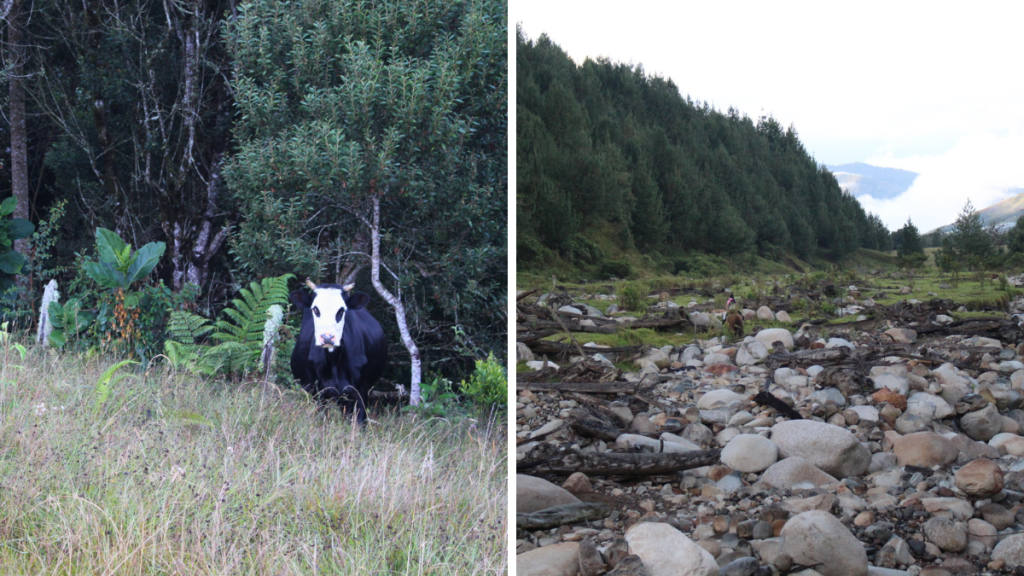
The chiva reaches its last stop. Not many people are left to disembark; the silence of the place is profound. There is only one small house, and the rest is yellowish pastureland, dotted with cows that can be seen from time to time.
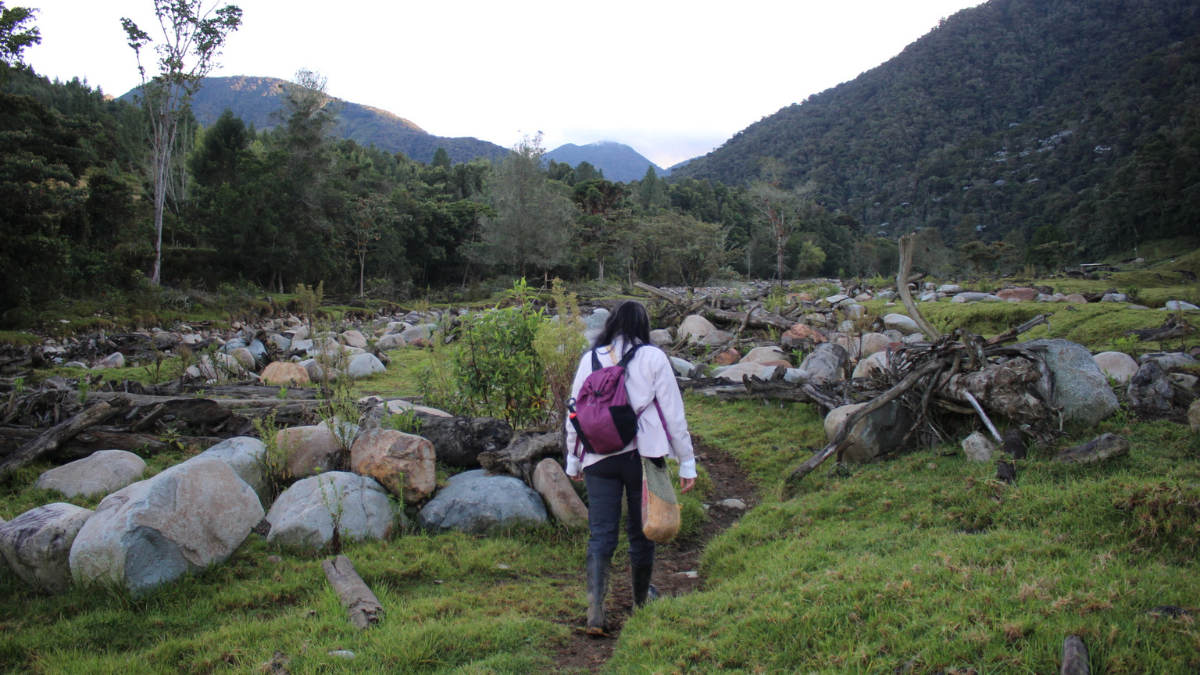
Ana begins walking, her steps firm. She remarks that there are hardly any tourists in the area, since the Páramo del Sol, one of the main attractions of the municipality, which extends behind the Colibrí del Sol reserve, has been closed since 2022.
“Over time, the paths became wider, which damaged the small frailejones [Espeletia shrubs], and the amount of garbage that people left behind began to seriously affect the páramo,” she recalls.
In the last week of September of this year, the Urabá Sustainable Development Corporation decided to extend the ban on mass tourism until 2026. This decision comes after more than a decade of complaints about pollution, fires, ecosystem destruction, and the destruction of frailejones. This measure will allow nature to recover its natural rhythm, while the forests and páramo regain their tranquility.
As Ana, a native of Urrao, makes her way to her destination, she pauses to photograph the páramo that stretches out in the background, observing the occasional tiny plant or animal moving among the faded grass. She recalls that plants have fascinated her since childhood; at first, she considered studying psychology, but ultimately chose biology.
During her visits to the reserves, Ana says that nature never ceases to amaze her: there is always a new color, an unexpected song, or a plant that moves her and renews her commitment to the forest.
She has walked through the 13 Proaves reserves, true sanctuaries of life that are part of the Almanegra project, such as Arrierito Antioqueño, Las Tángaras, El Paujil, and Loro Orejiamarillo. These places not only conserve species like the magnolia lozano and the hojarasco, but also other endemic trees and plants, such as the barrigón and the wax palm.
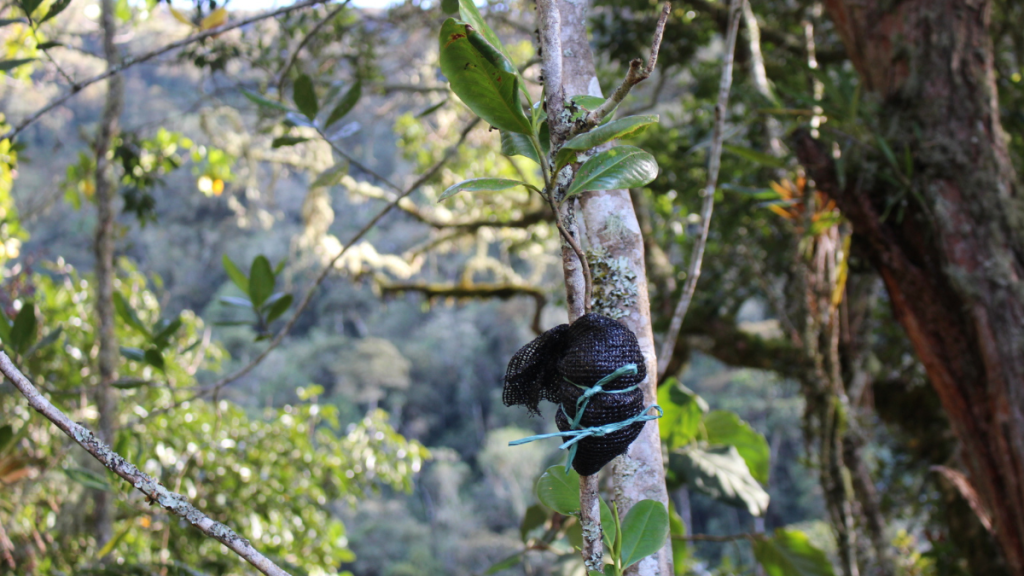
After a three-hour walk, a sign appears, announcing: “Welcome to the Colibrí del Sol Bird Nature Reserve, 1 km away.” Next to the gate grows a young Urrao magnolia. One of its branches is wrapped in a black tarp with soil: it’s an air layering, a propagation method that allows new shoots to grow from the same plant.
Ana says this method has its limitations, something they’ve come to understand through time and consistent work in the field. Air layering allows for the multiplication of individuals, but it doesn’t create entirely new trees in a genetic sense: each branch retains the same genetic information as its parent plant, its strengths and weaknesses. Therefore, even though they flower and bear fruit, these magnolias are more vulnerable to pests, fungi, and climate change.
This fragility has led the project members to seek more sustainable alternatives. In the nurseries, Ana and her team of women are experimenting with seed propagation, a slower but also more promising process. Each seed represents a different possibility, a small act of biological resistance that allows the species to diversify its genetics and increase its chances of adaptation.
Under the slow movements of the canopy, the biologist enters the reserve; the activity here is increasingly evident, with each falling leaf, the sounds of small insects and fluttering birds, marking the tireless passage of life.
This reserve was created in 2005 to protect the habitat of the Coeligena urina, known as the sun hummingbird, and to conserve a fragment of the páramo ecosystem. In this sanctuary of mist and diverse bird songs, 216 species of birds have been recorded—three of them threatened—that find refuge in these mountains.
Ana crosses a wooden bridge that creaks with every step she takes. In the distance, two yellow houses emerge from the forest, with green metal doors, black windows, and zinc roofs that reflect the gray sky—a sky that threatens to break open at any moment, covering the leaves of the trees with thousands of trembling raindrops while the silent cold persists in the surroundings.
At the entrance of one of the houses, Luz Amelvia Gallego Rivera, who manages the reserve’s nursery, waits calmly for Ana. She is originally from the village of Pavarandó, in Mutatá. For the past two years, she has shared her life at the reserve with her partner, Walter, who works as a park ranger.
“My partner told me about this place. He asked me if I wanted to come and work, and so here I am,” she says. “Ana told me about the project, and I said yes, that I thought it was a good idea to conserve the trees.”
Luz confesses that the cold took her by surprise at first.
“I haven’t been able to adjust. It’s too much,” she says with a laugh, rubbing her hands together to ward off the bone-chilling weather. She also talks about how difficult these outings can be: on the one hand, the distance; on the other, transportation, which always seems to be working against her. The chiva only comes once a day, in the morning. If you miss it, there’s no other option but to walk or ride a horse.
When she arrived at the reserve, she knew nothing about plants; she was a homemaker. But now, her mornings are spent among trays of damp soil, measuring magnolia seedlings and ensuring nothing harms them. She is one of the 10 members of the Almanegra project in the department of Antioquia. These members run the reserves’ nurseries and have received training in species identification, seed management, and the conservation of endangered trees.
The conservation process
It’s October, and at the Colibrí del Sol reserve, they’re preparing to harvest the almanegra fruit. Ana and Walter venture into the forest to find the seed trees, knowing that not all of them produce quality fruit. Using ropes, they climb to the highest branches to collect the fruit and, when necessary, place mesh baskets to protect it from loss or damage.
“The fruit is placed in egg cartons so it’s separated and well-ventilated. The fruit opens on its own, but it needs certain conditions: warmth and no humidity, because if there’s moisture, it won’t open on its own or it will rot,” Ana explains, while Luz keeps a watchful eye on what’s happening in the nursery.
Luz knows this is a slow process that requires patience and attention to every detail. When the fruit doesn’t open on its own, she intervenes gently, making sure no seeds are lost and that the cycle continues smoothly.
“Then we count how many seeds come out of each fruit and record the bad ones. The remaining seeds are placed in water to see which ones float and which ones sink,” she explains.
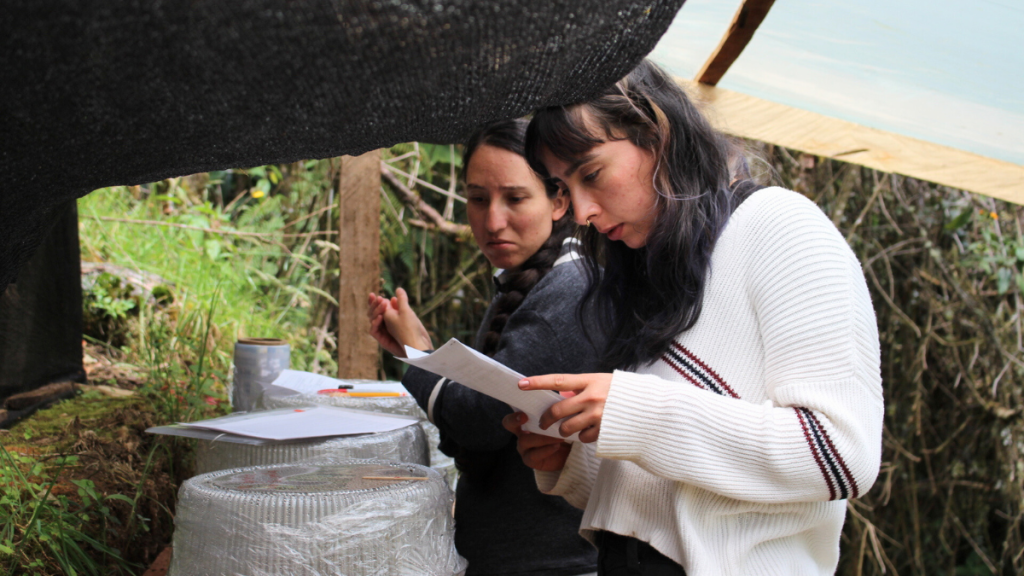
During this step, the water becomes the silent judge: the seeds that float are unusable, while those that sink are chosen for planting in the nursery. Each one carries with it the story of its parent tree, which is carefully recorded in documents to maintain traceability and preserve the memory of each seed.
Ana carefully separates the viable seeds from the non-viable ones, placing them in different containers. She examines each good seed closely before disinfecting it with a solution of iodine and ash, gently removing the outer layer. At this stage, some seeds are found to be non-viable because they are damaged internally and are discarded.
Throughout the meticulous process of disinfecting tools and seeds in the nursery, Ana patiently guides Luz. She explains in detail how to prepare the seeds, how to condition the germination trays, and how to organize everything for the upcoming harvest. Every gesture is carefully considered, and every explanation aims to convey not only the procedure, but also the respect and dedication that the life of these plants demands.
Seed germinators are large, clear plastic containers capable of holding over one hundred seeds. Before sowing, each seed is carefully disinfected with agricultural iodine to prevent the appearance of fungi or other pests, providing a clean and safe environment for the seeds to begin their delicate germination process.
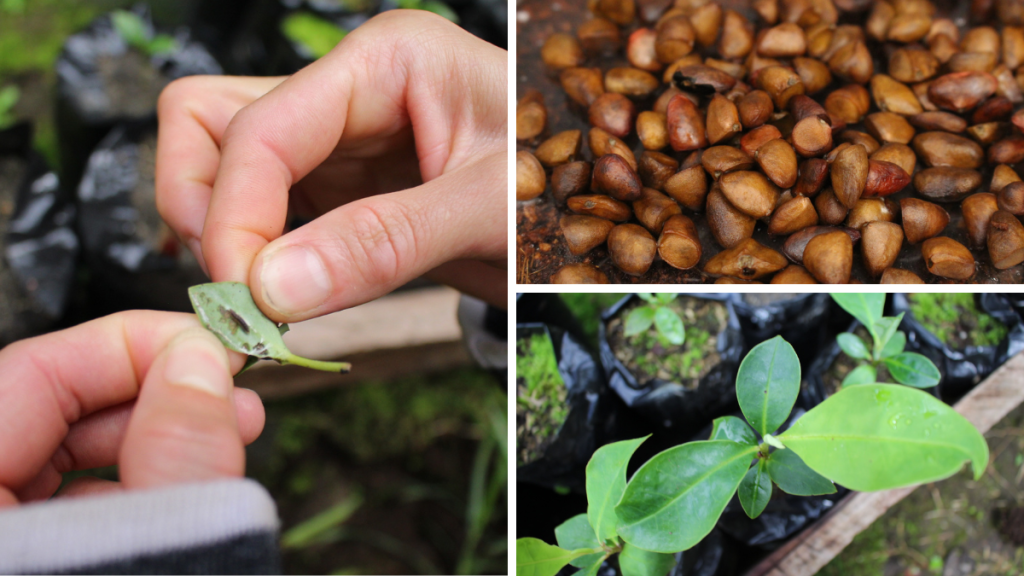
The biologist explains that the seed trays are made up of several layers: “A filter layer to allow water to pass through, an intermediate layer that can be sand, and finally the germination substrate layer, which varies depending on the species and can be sand or peat. In some magnolias, germination occurs very well directly in sand,” Ana says.
Challenges and lessons learned
During this germination process, they discerned that peat—an organic substrate made from partially decomposed plant remains—is perfect for the germination of the Urrao almanegra magnolia. Its ability to retain moisture without suffocating the roots, and to allow air to circulate, creates the ideal environment for the seeds to awaken and sprout with strength and vitality.
Ana also explains that the seeds shouldn’t be too close to the surface: “That’s why we make a small hole and place them lying down, since their root emerges like a small ‘navel’ that only develops correctly when they are in that position, and not if they are standing upright,” she says.
Luz explains that as soon as the root begins to emerge, the seeds are carefully monitored to protect them from pests like fungi or worms, until the seedlings show their first or second leaf. When they grow a little more, it’s time to transfer them to bags, which means they can be transplanted.
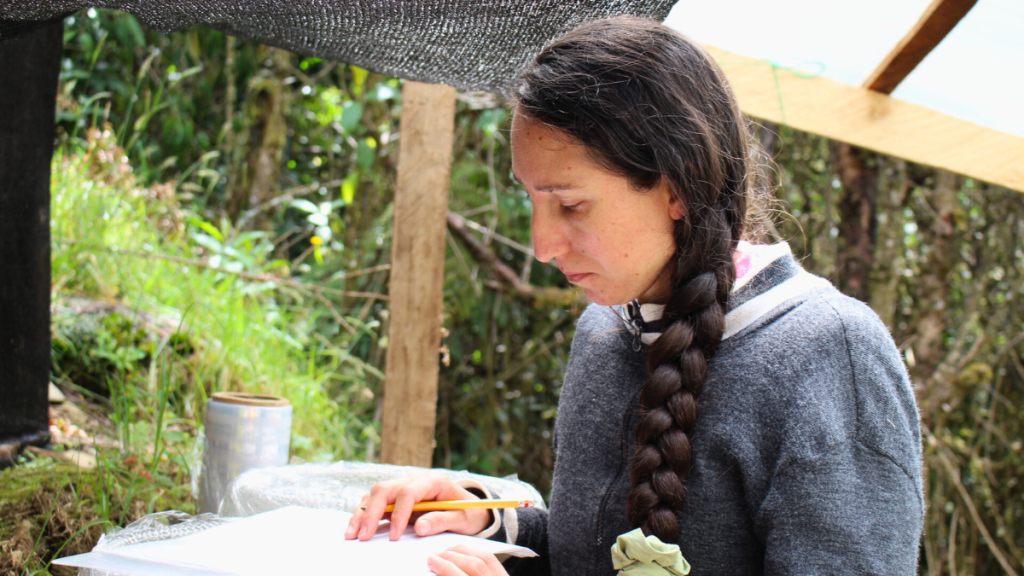
When the seedlings are put into the bags, the soil is enriched with compost, and mycorrhizae are applied to encourage their symbiotic relationship with these fungi. At this stage, Luz monitors their growth, counts their leaves, and controls the humidity, ensuring that each seedling grows strong and healthy.
“We record the height and the date they are monitored, as well as how many centimeters they measure and how many leaves they have. Everything we observe is also noted for tracking purposes,” Luz says.
Ana explains that the most fragile seedlings need denser shade, almost like a blanket protecting them from the sun and cold. As they grow and are moved to bags, this covering becomes lighter, as if they were slowly being taught to face the world on their own: “This gradual process allows them to slowly get used to the light, preparing the trees so that, when they leave the nursery, they can better adapt to the forest, where they will naturally grow under the shade of mature trees.”
When the young trees reach 80 centimeters, they embark on a new journey. They move into the hands of the guardians of the forest and those who live on the surrounding farms and properties, who plant them to continue the cycle of life. This is a patient, almost sacred act.
The soil that receives them is enriched with bokashi, a living mixture of organic matter, microorganisms, and sugar that feeds itself and transforms the earth. The mycorrhizae seal a pact of cooperation with the roots: nothing grows alone.
Forest rangers and farmers support this process, whether in the reserve or on nearby private lands—preparing the soil, planting, and monitoring their growth. Then comes the waiting, the care, the hope. Thus, slowly, the magnolias return to populate the memory of the forest.
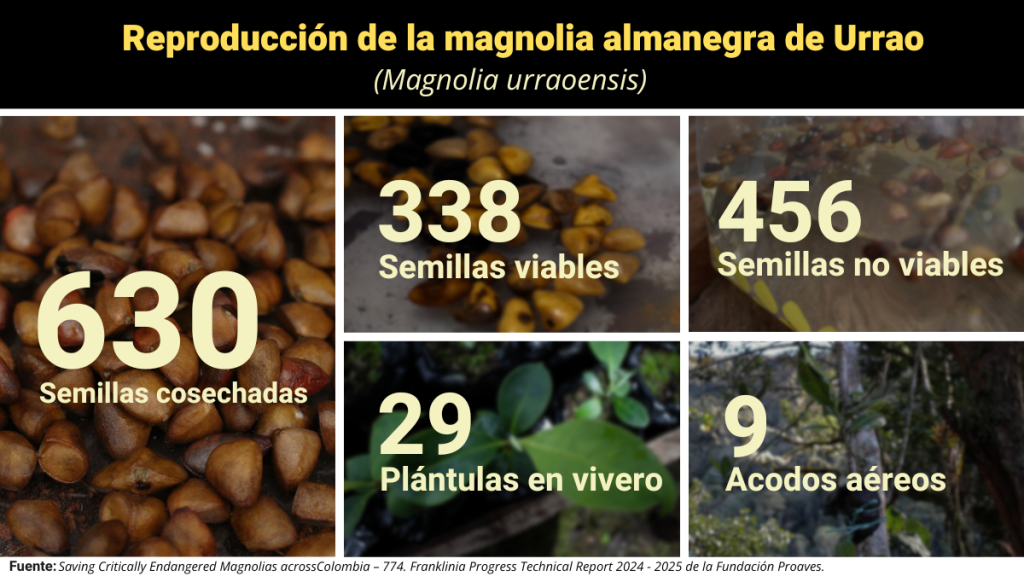
In the reserve, the day splits in two. The cold intensifies and the sun hides again, while the páramo, in the distance, is covered with gray clouds that foretell a storm. In the sky, thunder rumbles like drums, a sign that it will soon be torn apart. Amid this unsettling landscape, Ana and Luz exchange advice on caring for the newly planted magnolias: nearly 200 seeds of the Urrao magnolia rest in the earth, waiting to sprout.
Producing the almanegra is a challenging process. Each harvested fruit represents a hope that isn’t always fulfilled: less than half of the seeds survive, and only about 27% germinate in nurseries. Added to this are obstacles such as pollination, humidity control, and constant vigilance against pests, which make each new sprout a small victory against adversity.
But the challenges are not only biological: they are also human. The women in charge of the nurseries, without professional training and some even illiterate, have become the true guardians of conservation. Their learning comes from practice, from handling the seeds, and from patiently watching the tutorial-style videos that Ana creates and shares with them.
These women, facing educational and technical limitations, have transformed empirical knowledge into wisdom, and every day they challenge the idea that conservation doesn’t require degrees: all it takes is the will to care.
Ana carefully arranges her belongings. She says goodbye to Luz with a silent gesture and ventures back into the forest, pausing to observe the damp tree trunks, the dew-covered leaves, and the buds struggling to break through the leaf litter.
In the midst of her morning routine, she recalls that propagating the Urrao almanegra magnolia is no easy task: many seeds fail to germinate, many seedlings are lost to competition from other species, and the harsh weather. Every fruit that manages to sprout, every shoot that grows and survives in the nursery, is proof that life can prevail even in the most inhospitable places. In those forests of Urrao, where shadow and threat lurk around every corner, each tree that endures becomes a powerful testament to persistence and hope.