How did the first generation of ‘Journalism in Times of Polarization’ transform me?
I fell in love with journalism when I was 12 years old and in seventh grade. I still remember the exact moment perfectly. I was taking a course at the Costa Rican Institute of Radio Education (ICER), and they played a BBC London recording on an old stereo system—but in Spanish. When I heard it, it was like when the protagonists of a Mexican telenovela meet for the first time: I knew I had found the love of my life.
I fell in love with journalism, but especially with radio journalism. After working as a radio correspondent for cultural stations, which was the goal of that course, I took another one on radio and television broadcasting and on-air talent. I started working as a radio announcer when I was just 15. Later, when I entered university, I collaborated with other local media outlets. That’s how I experienced firsthand the reality of rural media in Costa Rica. These media outlets are mostly staffed by people who may never have had the opportunity to study journalism at a university, but who practice communication professionally and—with unwavering dedication—cover topics of public interest every day and keep their communities informed. They provide a service that is essential in a democratic country.
For that reason, I was deeply moved when I heard about the project “Journalism in times of polarization.” I felt drawn to participate in this initiative that seeks to build capacities for people who work in media outside the Greater Metropolitan Area.
My first task as project assistant for El Colectivo 506 and its Latin American Solutions Journalism Fund was to coordinate a national survey in which more than 100 communicators participated. The goal: to find out what their concerns and challenges were in the midst of our current national context.
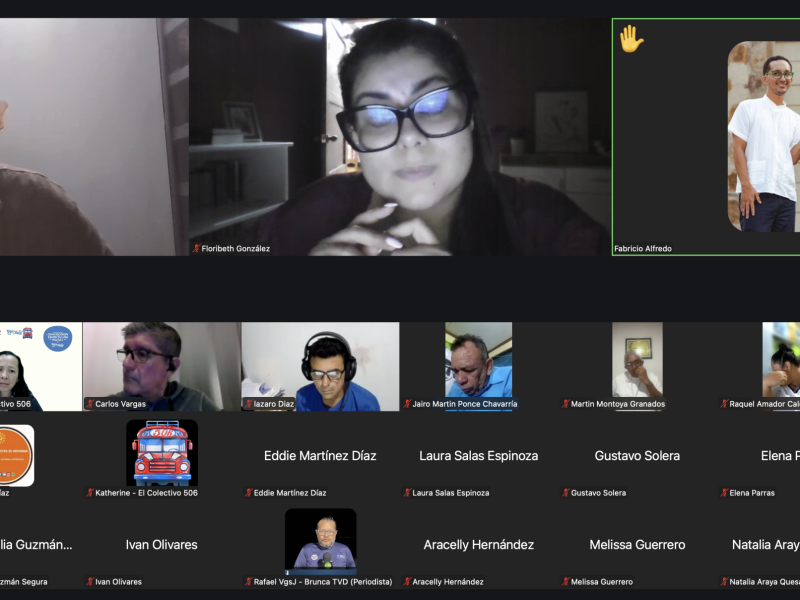
We used the information from those surveys as valuable input in creating five training sessions for a group of hyperlocal media leaders and communicators selected from among those who filled out the survey.
The classes were not only very valuable in terms of information and knowledge, but also because of the wonderful group energy, of absolute camaraderie, where we calmly shared our opinions and criteria about the day-to-day reality of the media.
Although I haven’t worked as a reporter for many years, I do remember my time working in radio, print media, and television in Pérez Zeledón. I also drew on my three years of experience as a journalist on the most listened-to radio news program in the country and from having practiced digital journalism when the wave of online media was just beginning.
This gathering among colleagues gave me the opportunity to deepen my understanding of how independent media outlets operate and why their role in democratizing information is key to serving our country. It allowed me to connect with the reality of the people who passionately, dedicatedly, and with immense sacrifice practice communication when resources are scarce.
It was extremely valuable that this course by El Colectivo 506 focused on promoting solutions journalism, because this encourages us to go beyond just reporting what happens on a daily basis, and helps us understand the complexity of the social phenomena we are facing. It helps us recognize the efforts to find solutions to these problems—or, in some cases, to recognize the absence of efforts and solutions.
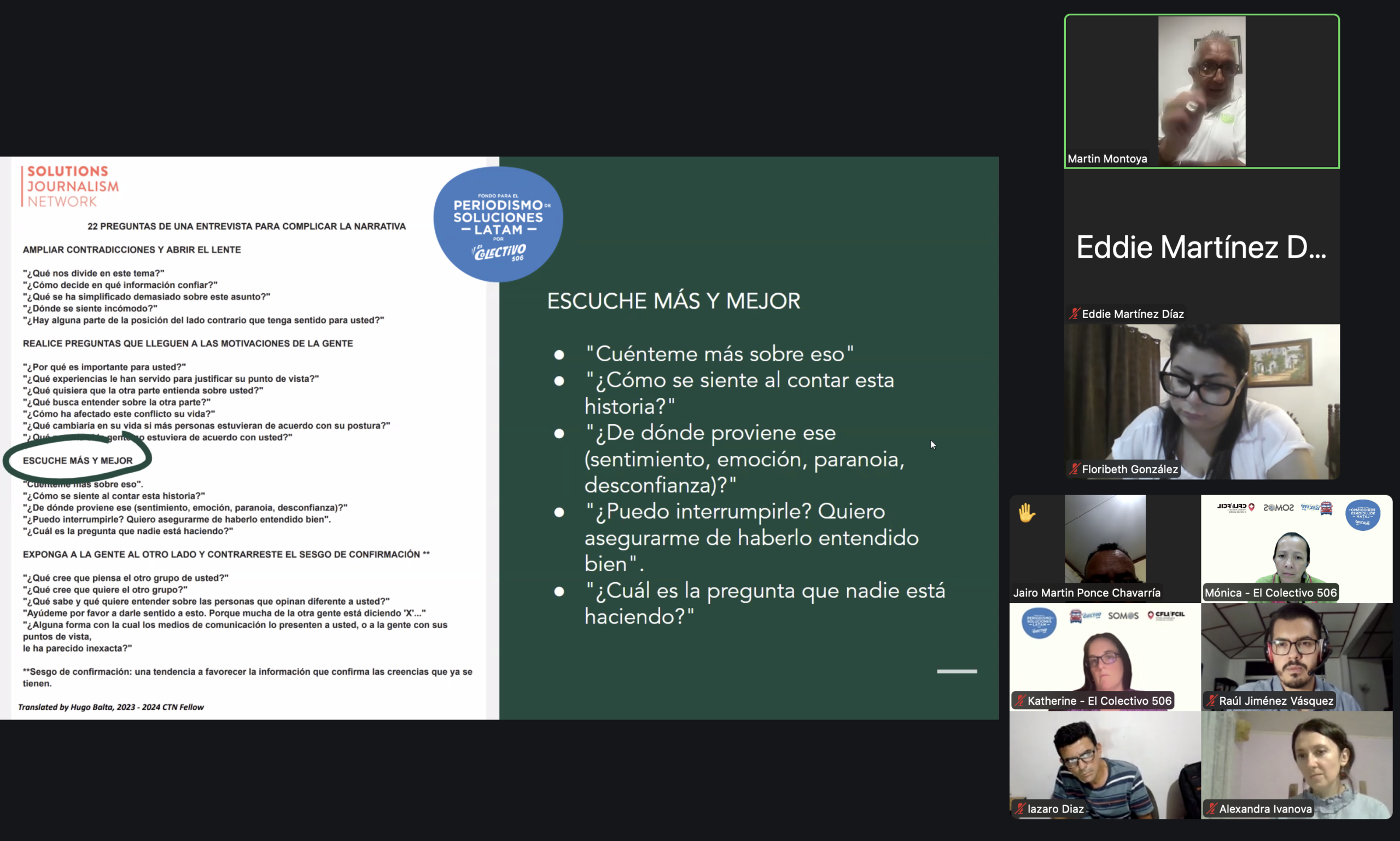
This type of journalism is important in order for media to help audiences understand the phenomena, but also to generate critical thinking; innovate regarding the solutions that the new challenges demand; and generate alliances between public, private, nonprofit and academic entities. Just as the problems are complex, the solutions also demand a variety of perspectives, approaches, experiences, knowledge and disciplines.
A journalist trained and able to understand this complexity—to see the whole picture, not just the individual tree but the entire forest, and to inform their audience with transparency and rigor—is a key element in strengthening and improving these solutions.
This project plays a critical role at this time. Costa Rica is facing a new electoral process and a new administration. Significant events are also unfolding globally: trade wars, armed conflicts, and structural changes. People feel overwhelmed by the sheer volume of information on both social and traditional media, leading to feelings of powerlessness and the belief that it’s impossible to take action within our limited sphere of influence to combat what we perceive as unjust or wrong.
For this reason, solutions journalism offers an opportunity for optimism, analysis, innovation, and human creativity to find solutions to the problems that humanity itself created.
I am deeply grateful for the opportunity to have met people who love journalism as much as I do, because I feel it is more necessary today than ever. Even with the weakening of media business models and the disrepute the press has suffered, journalism—I insist—is of vital importance. It is essential to democratize the practice of journalism and allow people to find space in the media to showcase their efforts and their attempts to find solutions to the complex problems of today’s society.
Furthermore, I’m delighted to have had the opportunity, at almost 35 years old, to participate in a project sponsored by the Canada Fund for Local Initiatives (CFLI), because that very course—where I first heard a BBC London broadcast and discovered I wanted to be a journalist—was funded by the Canadian Embassy. Seeing how developed countries continue to invest in creating opportunities for people to grow professionally and reach their full potential is truly inspiring.
Finally, I also want to thank the SOMOS Foundation and the Latin American Solutions Journalism Fund, an initiative of El Colectivo 506, for their leadership. Without Katherine and Mónica’s strength and vision, this project would have been impossible. I hope it is the first of many, because everyone—but especially those who practice journalism—needs spaces like this to discover and transform our own vision of who we are and the impact we can have on the world.
Author